-
-
Sea Stories from a Piano Bench
The Question That Started It All Before you read, take a moment to press play — this little piano piece sets the tone for the story. A little bird is singing in the yard. It’s Tuesday afternoon in Marseille. I’m sitting in the living room of my typical Marseille apartment, its floor covered with the…
-
Unlock the Circle of Fifths
Welcome to the 30-Day Transposition Challenge! This unique journey is designed to help you go beyond the basics and bring music theory to life through practical, hands-on transposition. In just 10 minutes a day, you’ll explore key signatures, and grow your confidence at the piano—all while working with famous classical melodies. Whether you’re a beginner…
Sea Stories from a Piano Bench
The Question That Started It All
Before you read, take a moment to press play — this little piano piece sets the tone for the story.
A little bird is singing in the yard. It’s Tuesday afternoon in Marseille. I’m sitting in the living room of my typical Marseille apartment, its floor covered with the famous tomette tiles, preparing for the 3 p.m. lesson. Sunlight dances gently on the mango and avocado leaves — two significant plants standing proudly next to the piano.
The doorbell rings, and my student arrives, smiling, full of energy, ready to play what she practiced during the week. She loves her music and enjoys playing it better and better. Her curiosity fuels our lessons — she’s the dream student, you know, eager to learn, always full of questions. Every new piece of information, every small improvement lights up her face.
At the beginning of the lesson, she tells me with a little giggle that she always plays better when no one is listening. It’s not so easy to perform, even the simplest music. I completely understand her; it wasn’t easy for me either at the beginning. It became better when I had my first job as a cocktail pianist aboard a cruise ship.
Then she looks at me, asking:
“Why did you start playing on cruise ships? Why did you leave your home country?”
You know those moments when time stops, and you suddenly don’t know what to say? That was one of them. Because… how could I possibly answer in a few sentences?
I hadn’t thought about it for a long, long time. It was like opening a dusty drawer in the attic of an old house — a drawer filled with souvenirs, photos, little objects, melodies, a total mess. Like a 1000-piece puzzle.
I stared at her, wide-eyed, took a deep breath, and finally answered: “Excellent question. Well… it all started with a desperate moment.”
The lesson went on — we played, we learned, we laughed. She left, but her question stayed. I realized: it had been a long journey — one not only of distance, but of identity, risk, and transformation.
Now, I enjoy the sunshine in my living room, and sometimes, I walk down to the beach in this wonderful town. Back then, I lived on the sea, and from time to time, I visited land. Settled now; always on the move then. What a contrast!

Why did I leave the well-known for the unknown? It’s a story I’ve carried for a long time. Now feels like the right moment to unfold it — for you, and for me. Let’s open that old drawer together and look at the souvenirs with more experienced eyes. Let’s solve the 1000-piece puzzle and see the picture.
My student’s question brought me back to the beginning of it all. One moment, one decision that changed the entire curve of my life.
At that time, I was a piano teacher in Hungary, holding a freshly obtained Master’s degree in piano performance and teaching. I gave lessons in a music school, but played less and less. I had lost my motivation to practice. The daily struggle of earning a living clouded every day. I felt a growing gap between what I had been preparing for during my studies and what I was actually doing.
I couldn’t see where that path was leading. Everything felt uncertain and heavy, and I knew I had to change something radically. That was the day I found an agency looking for pianists for cruise ship contracts.
Needless to say, I knew nothing about cruise ships or cocktail pianists. I didn’t know what repertoire I was supposed to play, how the job worked, what mattered most. And, I knew I got motion sickness even in cars and buses! Imagining myself on a ship seemed… surreal.
And yet, somehow, I thought: “It can’t be worse than this.” I closed my eyes and jumped. I sent my application to the agency. My life changed on that cloudy day. It was the beginning of a brand-new chapter.
This blog post is only the first of a series of 10 short stories. Dear reader, come along with me — from the avocado and mango plants to another piano bench — one floating on the sea, aboard a cruise ship. Let me tell you a story of crossing countries, changing repertoire, and moving through life’s chapters.
Sometimes, the biggest questions arrive quietly, with sunshine on your face and a piano nearby.
If you enjoyed this story, stay tuned for the next chapter!
Unlock the Circle of Fifths
Welcome to the 30-Day Transposition Challenge!
This unique journey is designed to help you go beyond the basics and bring music theory to life through practical, hands-on transposition. In just 10 minutes a day, you’ll explore key signatures, and grow your confidence at the piano—all while working with famous classical melodies.
Whether you’re a beginner or returning to the piano, this challenge will help you build a strong musical foundation and take your skills to the next level.
What’s the Challenge About?
We’ll take a short melody each day and transpose it into every key. We’ll start with simple tunes and gradually work our way up to more complex melodies. Through this approach, you’ll internalize the structure of key signatures, gain hands-on experience with the circle of fifths, and develop an intuitive sense of the piano’s layout.
How Does It Work?
Each day’s session is brief, designed to fit into even the busiest schedule. You’ll find a new video on my YouTube channel, guiding you through the day’s melody and transpositions.
To make this experience even more immersive, you’ll have access to a downloadable tracker and a private Facebook group, where you can connect with others, share your progress, and receive feedback from me and fellow participants.
How to Participate?
- Subscribe to my YouTube channel for daily video notifications.
- Download the tracker to log your progress and stay motivated.
- Join our private Facebook group to share your experience, ask questions, and connect with others on the same journey.
The Benefits of Transposition
Transposing music daily brings multiple benefits that build up your skills and deepen your musical understanding:
Internalize Musical Vocabulary: Transposition strengthens your familiarity with chords, scales, patterns, and motifs. Each repetition in a new key reinforces these elements, making them second nature.
Boost Sight Reading and Recognition of Patterns: Seeing and playing the same melody across all keys helps you spot patterns immediately and play them with ease, an invaluable skill for sight-reading.
Build Confidence with Less Common Keys: Tackling the full range of key signatures, including those that are less familiar, will give you confidence in any musical context.
Strengthen Your Foundation with Beginner-Friendly Melodies: Starting with simpler pieces allows you to develop a solid base, ensuring that you’re building skills progressively and sustainably.
The Key is Regularity
Consistency is the magic ingredient that makes all these benefits stick. When we practice every day, even for just 10 minutes, we create a lasting foundation for these skills. With each daily session, you’ll be amazed by how quickly you feel more comfortable at the piano!
Benefits of Active Participation
Transformation in music comes from doing. Intellectual understanding is helpful, but the true skill is built when you play, practice, and participate. By committing just 10 minutes daily to play along and transpose each melody, you’ll experience real improvement.
Join Us Today!
Start your journey whenever you’re ready—this challenge is designed to be flexible and adaptable to your schedule. Download the tracker, watch the Day 0 video, and get ready to dive in. I can’t wait to see you there!
Triplets Against Eighth Notes in 3 Easy Steps
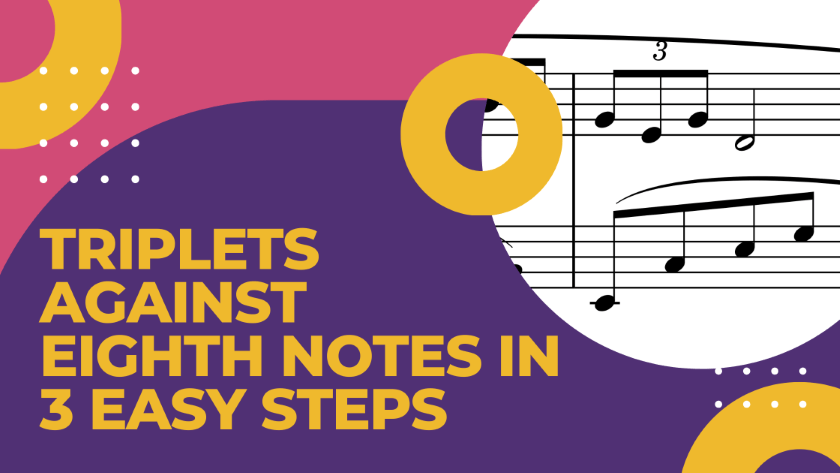
“Triplets against eighth notes” is one of the most famous examples of polyrhythm. It is also called cross-rhythm, and it appears in different genres of music. To mention one of them, here is an excerpt from Debussy’s Arabesque No 1.
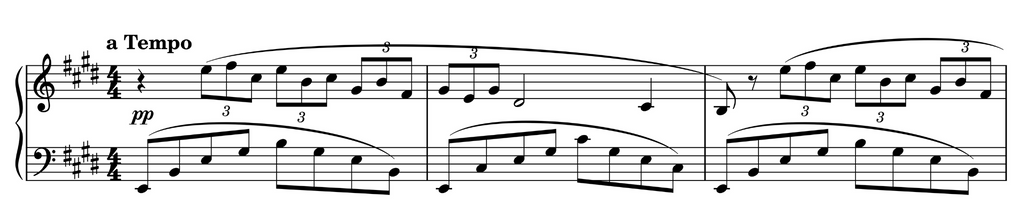
It gives the impression of dancing, and the music becomes vibrant. At first sight, it seems elusive, almost arbitrary. It takes a bit of analysis and practice to master this rhythmic figure. To make it part of your skill set, all you need to do is follow these 3 Easy Steps.
Step #1
Understanding
The first step is understanding how to put 3 notes of equal length and 2 notes of equal length in the same time unit.
Let’s start with the common multiple of 3 and 2 on a piece of staff paper. Fill a 3/4 measure with 6 eighth notes as shown in the example below:
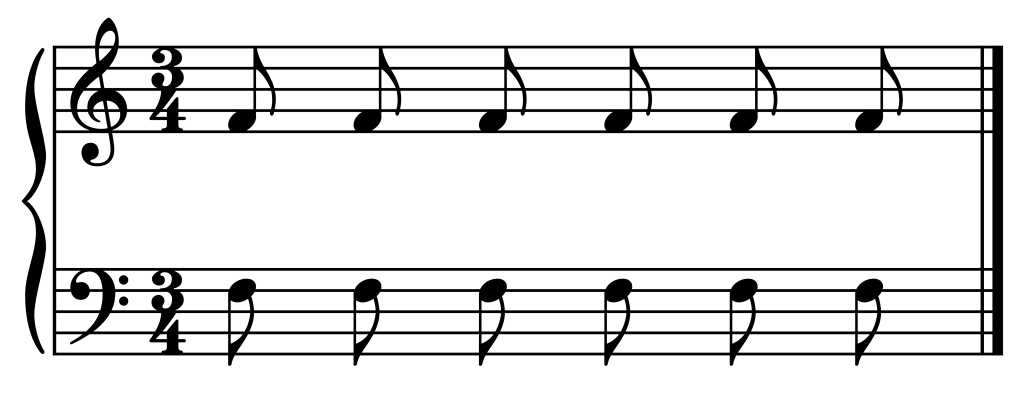
Create equal groups in both hands. 3 groups in the right hand, and 2 groups in the left hand.
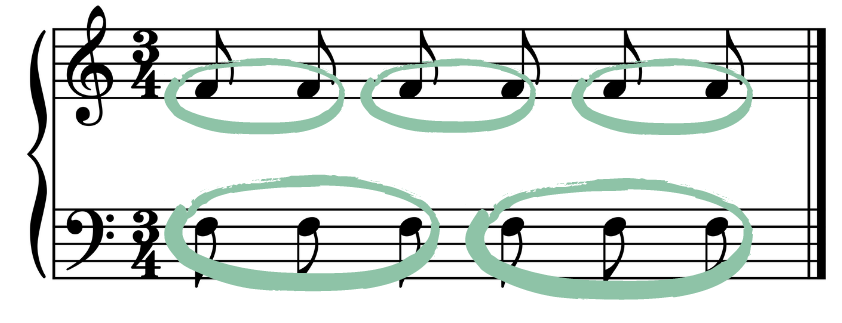
Transform the circles into beams:
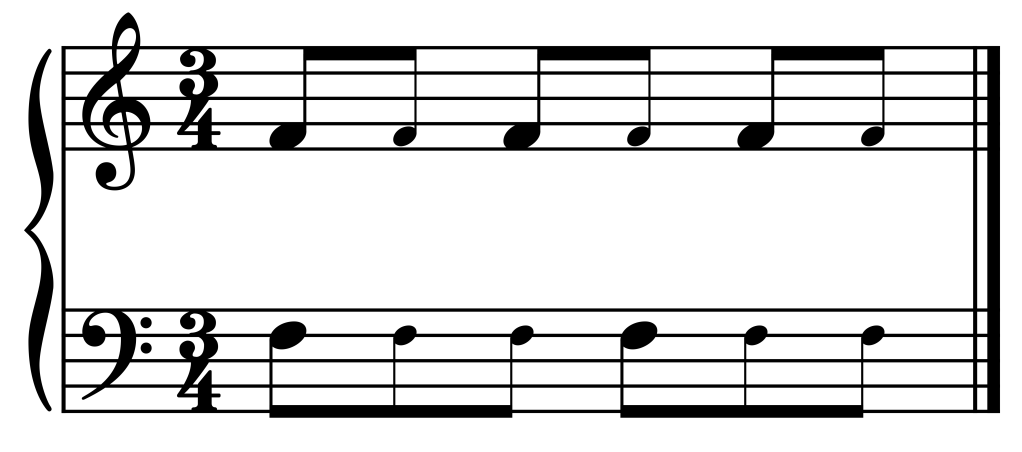
Let’s see what happens when we decide to play only the first notes of these groups.
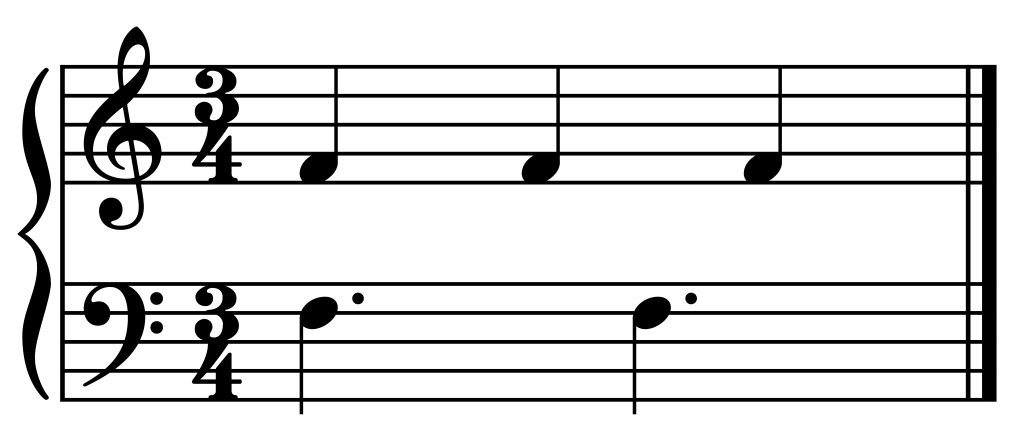
Observing the example above, you might notice two things.
- The two hands start together
- The order of the hands for the last three notes is Right, Left, Right
There are three notes against two in a measure. What if we convert it to a beat? Three notes against two on each beat, and here they are, triplets against eighth notes:
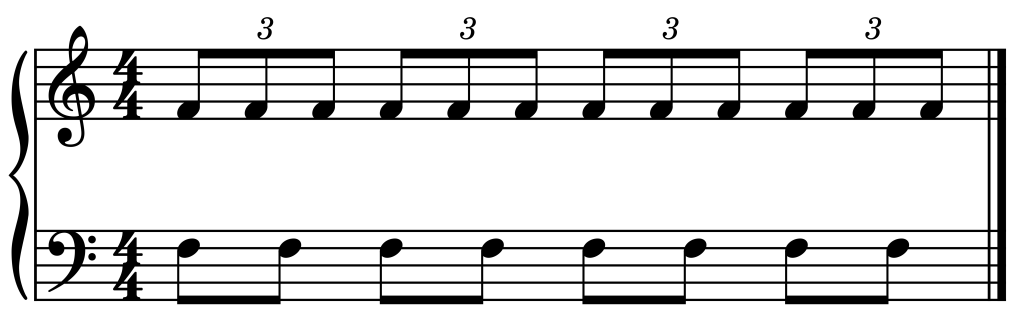
Conclusion: the second note in the left hand comes between the second and third notes in the right hand.
Step #2
Feel the Rhythm
Understanding is a good starting point. Now you are ready to go further and put your knowledge into action. The second step is to feel the rhythm. For that, we do a simple exercise: tap the rhythm on the piano lid.
As you can see in the example below, the right hand is tapping triplets, and the left is tapping eighth notes. With all that, count the triplets out loud.
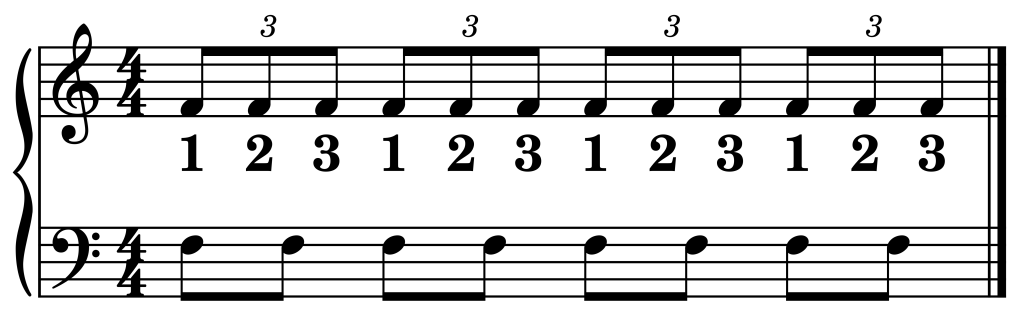
Practice this exercise until it becomes easy. What does it mean? It means that the rhythm plays itself. It means you keep track of your triplets and tap your rhythm correctly while looking around the room, out of the window, and watching the people on the street.
At this point, start counting the eighth notes. Reach the same ease that you already have with counting the triplets.
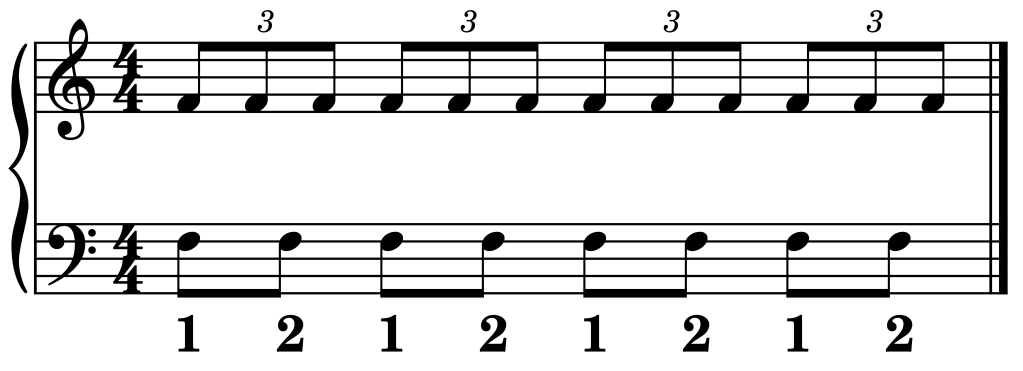
Combining the two is the next level when you switch between counting triplets and counting eighth notes by measure. The change has to be seamless. Attention: a barline does not mean extra time to think. To make sure that you are precise, use the metronome.
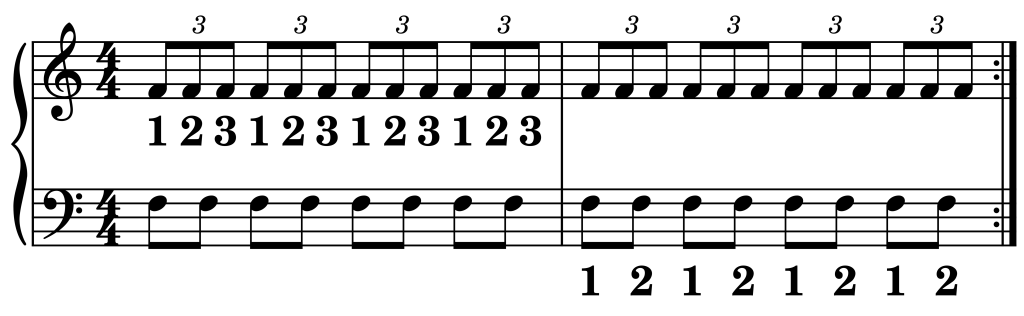
By now, your movements are automatic when the triplets are in the right hand. Let’s see what happens when we put them in the left hand.
Just like in the case of the previous exercises, spend enough time on this one too. Practice until it becomes easy. Think about the goal: while playing different notes and nuances in a piece of music, there is no time for hesitation about the rhythm; we want to feel the rhythm.
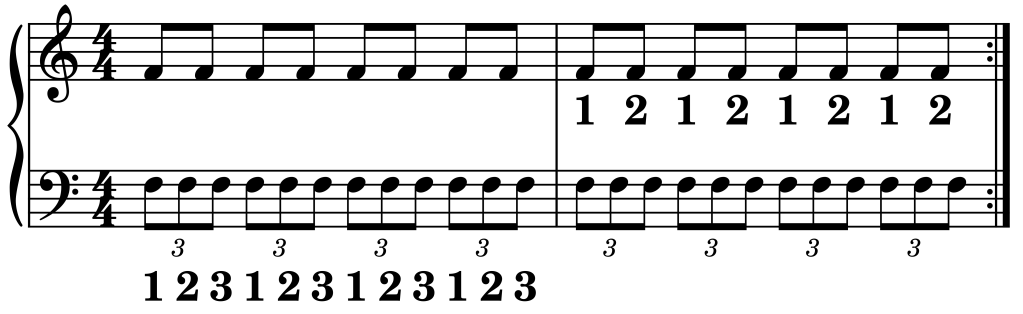
In summary: there are four elements in this exercise.
- Tapping triplets
- Tapping eighth notes
- Counting three
- Counting two
I invite you to create your exercises. Mix up these elements, and switch between the hands and the counting. You can even use different tools to tap the rhythm. Sparkle your creativity!
Step #3
Play Music
The movement of the cross-rhythm is in your hands by now. You understand it, and you feel it. We reached the final step of this practice, it is time to play some beautiful music!
Choose a short piece of music where you play triplets against eighth notes. Start with a few measures, and practice them slowly focusing on the rhythm.
As a final touch, here is a little bonus for you. Each exercise above is available in this video:
Happy practice!
5 Practice Tips to Manage Stage Fright
No Anxiety, No Zone.
For a few years, I had the chance to play on cruise ships. The advantage of this experience was that I played every single night. That means plenty of opportunities to live through stage fright.
I soon realized that trying to eliminate stage fright is a mistake. The performance becomes flat and passive. A certain degree of anxiety helps to get into this magical state, the Zone.
With this realization, a new opportunity appeared for me. My goal was to become friends with stage fright and make it my ally.
The problem of stage fright turned out to be a great resource. It forces us to think about our preparation and our way of practice. What can we change? How can we change it?
Tip #1
Deliberate Practice
„Repetition is the mother of learning.”
The question is how you repeat. Repeating something, always in the same way, does not make it necessarily better. Repetition with a strategy and a plan makes a difference.
Instead of repeating the same piece of music on autopilot, try this practice method.
- Choose a short musical excerpt.
- Set up your recording device and play it once. Imagine you play it in a recital.
- Listen to the recording and ask yourself: What do I want to change?
- Choose three elements you want to change. It can be the dynamics, articulation, phrasing, etc.
- Continue asking yourself: How can I change it?
- Choose an action for each of the three elements above. For example: change the fingering, your posture, the tempo, etc.
- Write down your answers, and be specific. Writing your answers down helps you to get a clear plan.
- With a clear plan in mind, record the music one more time. Listen to the recording, and observe your changes. Did they work?
- If yes, hurray, you found the solution. If not, go back to the question, „How can I change it?” and come up with a different answer. Record it one more time, and observe.
- Repeat the process until you like what you hear.
Warning!!
When you start with this practice method, do it only in a small amount. Do not change your entire practice routine in one day. Do short sessions regularly and expand the time step by step.
Tip #2
Interleaved Practice
You never get a second chance to make a good first impression.
Will Rogers
Often, we work on a challenging passage, and after a certain amount of trials, we can play it. Maybe we play it very well. However, in a concert situation, a mistake occurs. Always at the same measure.
Interleaved practice solves this issue.
- Choose three excerpts from your repertoire; A, B, and C. Preferably from different eras or styles.
- Set up your timer for 3 minutes.
- Play A for 3 minutes, switch to B for 3 minutes, then C.
- Repeat the process three times.
You might think: „I just started to get into this piece, and I have to switch to something else?!”
Yes, exactly. Believe it or not, that happens when you perform. There is no warm-up on stage. There is only the first impression. With interleaved practice, you prepare yourself for a confident start.
Warning!
Interleaved practice is frustrating at first. It does not give you immediate feedback on improvement. It challenges long-term memory, and shows you how you play the music the first time. Not the second trial, not the third.
Tip #3
Attentional Endurance
Attentional endurance is the ability to stay focused for long periods. Clearly, it is an essential performance skill.
It means you spend time with practice without checking your phone, emails, or social media. You are not checking them while performing, are you?
Remember, you play the way you practice.
While practicing, only to see that you received a message will distract you. You are not in the zone anymore, and it takes time to be focused again. You are losing precious practice time and energy. These little distractions reduce attentional endurance.
To avoid wasting time and energy, create a distraction-free practice environment. Keep your practice space clean and organized. Sticky spots, rubbish, and waste paper distract from the learning process.
Disconnect all devices or put them in airplane mode. Every message or call will distract you even if you don’t pick up the device.
Attentional endurance is an essential skill that you’ll need in order to play your best in recitals.
Tip #4
Pre-Performance Routine
The day of the performance arrived. You are in the greenroom, and ready to play. Suddenly, just before you go on stage, you feel cold, and your nerves are at their peak. Doubt, uncertainty, and second-guessing want to sabotage your performance. Does it sound familiar?
The pre-performance routine helps precisely at these moments.
To practice the routine, choose a short musical excerpt.
- Now, sit or stand in a comfortable position. Take a few slow, deep breaths. Inhale through your nose, exhale through your mouth.
The air may feel a little cooler and drier on the inhale, a little warmer and humid on the exhale.
- As you continue to breathe, scan for tension that you might be unaware of. Release tension from your eyes, mouth, and jaw. Then your neck, shoulders, and upper back. And so on, all the way down to your feet. Your body is a little more relaxed, and breathing has helped you to quiet your thoughts.
- Hear before you play.
Imagine the opening phrase of the music you have selected. Hear it exactly the way you’d like it to come out of your instrument. Focus especially on the first note or two (or the first chord).
- Feel before you play.
Remind yourself how your body, and perhaps your arms or hands, feel physically. When you let go, and everything works just the way you want. The idea is to focus on the big picture, and how things feel overall.
- Let go.
When all of this comes together, take one more breath. Then without hesitation or any further thought, just go for it. Play the first two lines.
How do you feel now? How did it sound?
What you just did is an example of a pre-performance routine. As with any other routine, it has to be practiced and turned into an automatic habit.
So take that same excerpt of music that you just used. Set aside about 10 minutes and do seven repetitions of the entire process. Keep doing it daily until it becomes a routine.
Using a pre-performance routine helps you to get into the zone from the very first note of your performance.
Tip #5
Practice Performance
Experience helps to deal with stage fright. Share your music, play for others, and experience as many concert situations as possible.
A good way to create a concert situation is to organize events for family, and friends. It can be a live concert for a handful of people. At a small place with a piano, maybe a grandparent, uncle, or aunt has one. You can do it online as well.
Details matter!
- Even if you do your practice performance online, wear your concert outfit. It is a good opportunity to test the shoes, dresses, earrings, and ties, avoiding unpleasant surprises later.
- Do everything just as you would do at a high-stakes performance. Walk on stage, bow, play, bow one more time, and go backstage. Even if you play for a tiny audience, stage presence is a significant part of the performance.
- Record yourself for post-performance reflection. These precious recordings allow us to observe our performance. While watching the recording, take notes and include your ideas in your practice planning.
The Key Is Regularity
These five practice tips require time and repetition. When I say time, I do not mean hours of practice a day. All of them are attainable with short practice sessions. The key is regularity.
Download this checklist for your next practice session. Use it regularly to keep you on track and focused. Create new practice habits and become friends with stage fright.
For further details I recommend Noa Kageyama’s website: https://bulletproofmusician.com/
I find it extremely useful, with reliable information, and effective exercises.
Happy practice!
 Source of Music